
Brought to you by: Blockhub Hat! “AKA The BH HAT”
February is where good intentions get audited.
January runs on declarations. New calendars. Bold promises.
February is quieter. More honest. It asks a single, uncomfortable question:
What’s actually holding this together?
At BlockHub, we’ve learned something that saves time, money, and sanity:
Motivation is temporary.
Structure is dependable.
And businesses built on temporary fuel don’t age well.
When plans fall apart, people blame willpower.
But current research continues to show something more fundamental: people can genuinely intend to act and still struggle to follow through—often described as an intention–behavior gap in applied settings. PLOS
In other words:
People don’t fail because they don’t care.
They fail because their plans don’t account for reality.
Vague goals create friction. Clear structure removes it.
Recent meta-analytic research continues to support that implementation intentions (clear “if–then” planning: when X happens, I do Y) improve follow-through because decisions are made before the moment gets messy. ScienceDirect+1
This isn’t about control.
It’s about reducing decision fatigue when it matters most.
The familiar “21-day habit” idea doesn’t hold up.
A 2024 systematic review and meta-analysis (published in Healthcare) reinforces the finding that habit formation timelines are highly variable and typically take weeks to months, not days. MDPI+1
Public-facing 2025 coverage of that same paper makes the takeaway even clearer: the range can be wide, and habit formation is rarely quick. News-Medical
So if something still feels effortful in February, that’s not failure.
That’s construction.
Longitudinal research published in Psychological Science (2025) tracks adherence to personal resolutions over the course of a year and finds that the quality/type of motivation predicts adherence over time—meaning early enthusiasm isn’t the whole story. SAGE Journals
Strong systems are built with that reality in mind.
Weak ones quietly assume motivation will stay high.
It won’t.
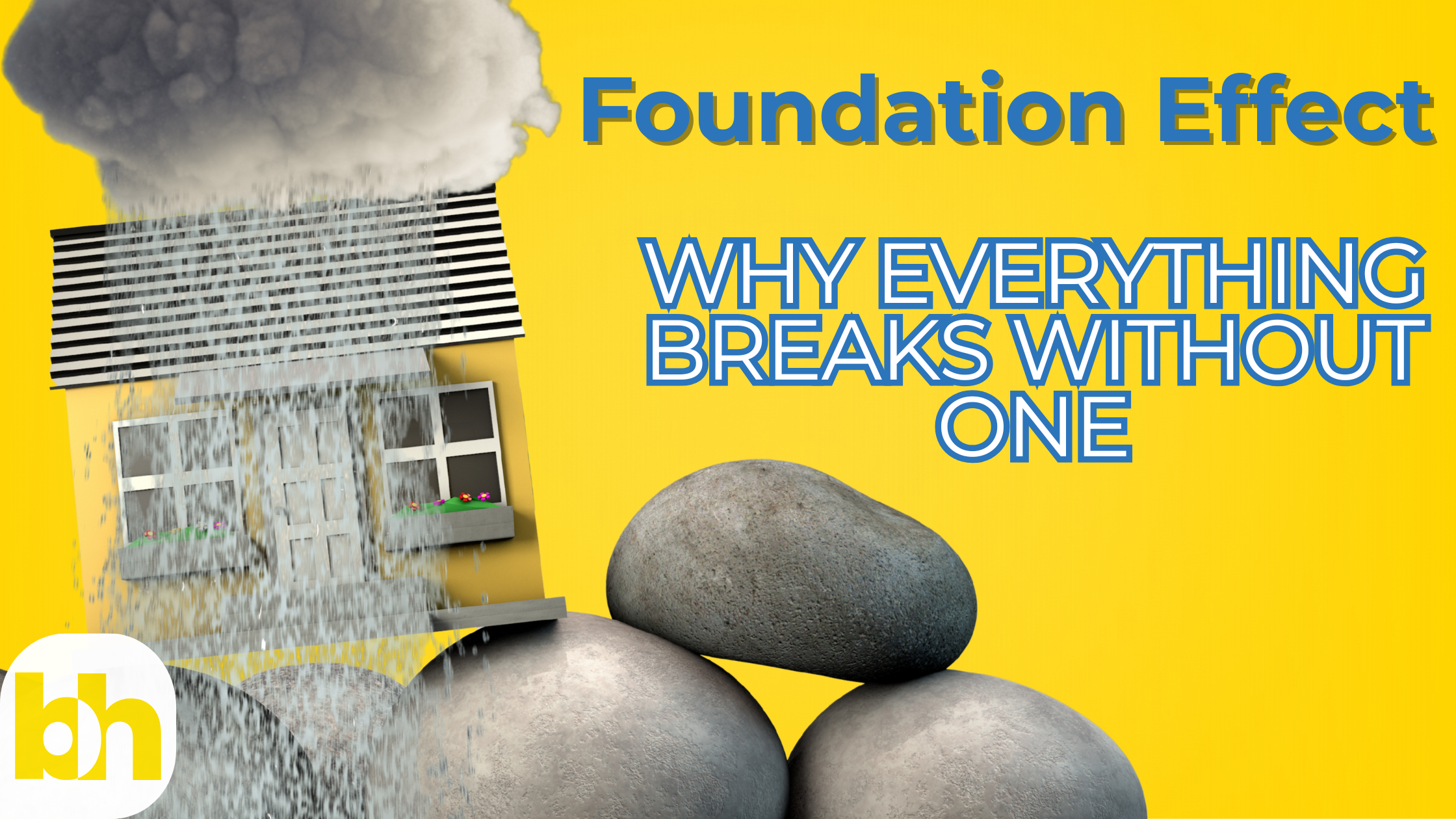
A foundation is not a tool.
It’s a decision architecture.
It’s the set of choices you make once, so you’re not forced to renegotiate them under pressure.
Foundations answer questions like:
If the answer is “it depends,” the foundation is missing.
Things don’t collapse because people lose interest.
They collapse because nothing is load-bearing.
When attention dips, deadlines stack, or life interrupts, unsupported plans quietly dissolve.
That’s why February exposes weaknesses January hides.
Not because people stopped caring —
But because the structure was never there to carry the weight.
This week, choose one area that keeps stalling.
Then define four things — clearly, simply, once:
That’s not motivation.
That’s infrastructure.
If February is exposing cracks, that’s not a failure — it’s information.
This is the moment to stop pushing harder
and start supporting smarter.
At BlockHub, we help founders and teams build foundations that don’t rely on motivation — systems, rhythms, and strategies that hold even when energy dips.
If you’re ready to:
Put the right hat on your business.
Book a 15-minute Foundation Session
blockhubcreative.com/contact
No pressure.
No reinvention.
Just a clear look at what needs reinforcing — and how to do it well.
Because progress shouldn’t depend on perfect conditions.
It should rest on a foundation that lasts.
1) Intention–behavior gap in applied research (PLOS ONE, 2024):
https://journals.plos.org/plosone/article?id=10.1371/journal.pone.0311442
2) Implementation intentions meta-analysis (ScienceDirect, 2025):
https://www.sciencedirect.com/science/article/abs/pii/S2352550925000260
3) Habit formation systematic review + meta-analysis (Healthcare/MDPI, 2024):
https://www.mdpi.com/2227-9032/12/23/2488
4) Press release referencing the same 2024 meta-analysis (EurekAlert, 2024):
https://www.eurekalert.org/news-releases/1071242
5) 2025 explainer coverage summarizing the 2024 meta-analysis (News-Medical, 2025):
https://www.news-medical.net/news/20250128/How-long-does-it-take-to-form-a-healthy-habit.aspx
6) Resolution adherence across time (Psychological Science / SAGE PDF, 2025):
https://journals.sagepub.com/doi/pdf/10.1177/09567976251350960

At Blockhub, we’re passionate about creativity, data-driven strategies, and delivering results. Let us be your partner in success.
Get Social